Prices Are Stable. Buyers Are More Selective.
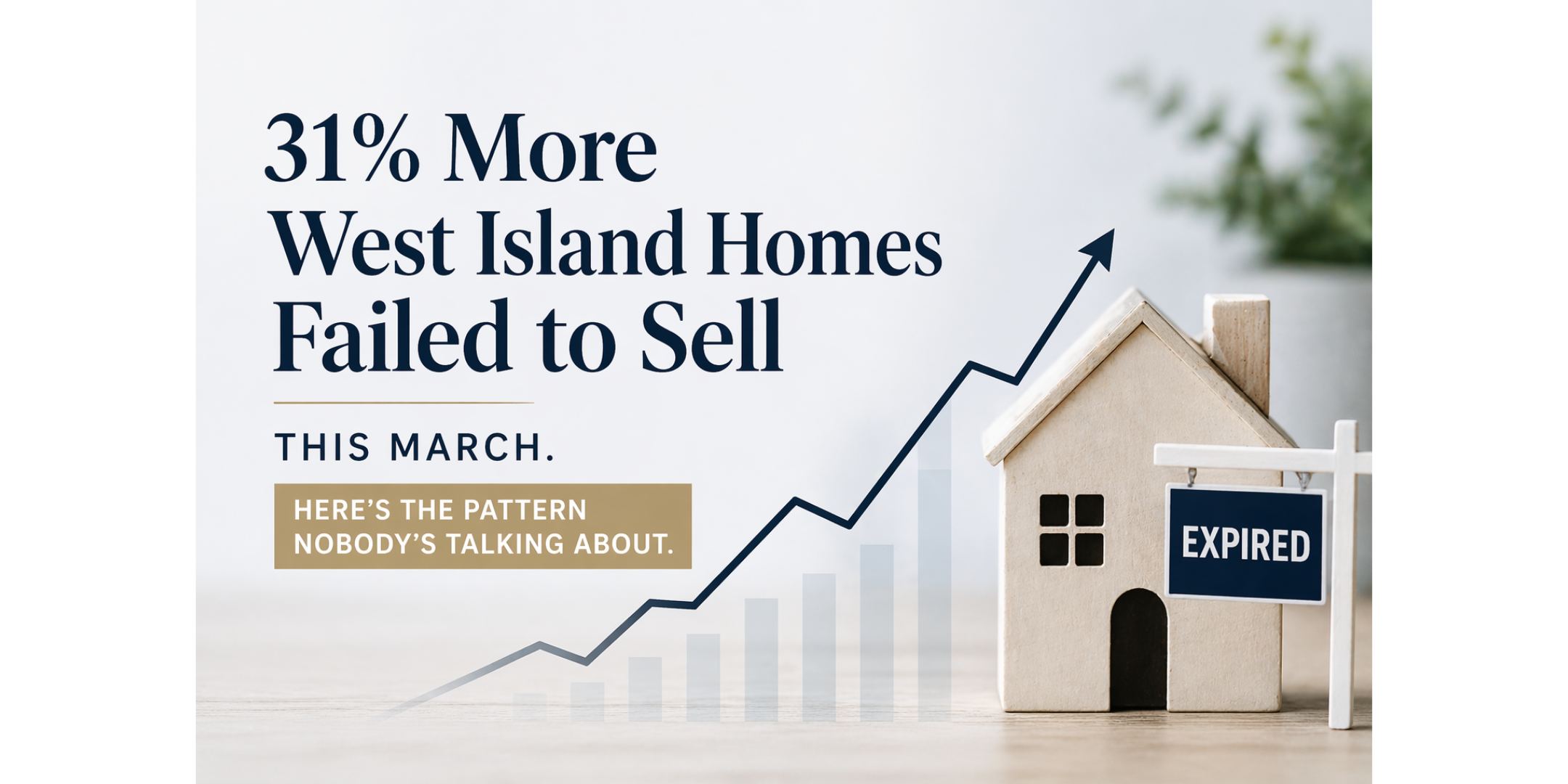
Median prices look fairly steady across the West Island, but cancelled and expired listings are telling a more important story.
Two homes. Same street in Beaconsfield. Same month. One sold in nine days, over asking. The other was cancelled after 90 days on the market. The difference wasn’t the market. It was the pricing strategy.
That split is the clearest signal in today’s West Island market, and it doesn’t show up in median price data.
The most useful question right now is not just what sold. It’s what failed to sell, and why.
The sold data tells us what buyers were willing to pay. Cancelled and expired listings tell us where sellers overshot the market, where buyers pushed back, and where pricing strategy broke down. In a market like the West Island, that distinction matters enormously.
The Broad Picture: Stable Overall, Uneven Underneath
On the surface, the West Island single-family market looks relatively stable to start 2026. In January and February combined, total new listings across the West Island were down modestly year over year, while average active inventory was essentially flat.
That does not suggest a market that is falling apart. It suggests a market that is holding steady overall, but uneven once you look closer.
Some municipalities are clearly carrying more inventory than others. Dollard-des-Ormeaux (DDO) saw both new listings and average active listings rise meaningfully. Baie-d’Urfé and Sainte-Anne-de-Bellevue also saw an active inventory increase. On the other side, Pointe-Claire, Dorval, and Senneville saw inventory tighten, while Beaconsfield remained comparatively balanced.
The West Island is not one market. It is a collection of micro-markets, each behaving differently by municipality, product type, and price range.
Median Prices Look Stable — But That’s Not the Full Story
Median price is part of the conversation, but doesn’t tell the whole story. A shift in median price doesn’t automatically reflect a true change in underlying home values. Sometimes it simply reflects the mix of homes that sold in a given period.
The better read right now is this: prices appear broadly stable, but buyers are becoming more selective on value. That is a much more accurate description of what the data is showing — and it’s a meaningful distinction for anyone planning to buy or sell in the coming months.
Beaconsfield Deserves Its Own Conversation
If we’re going to talk about the West Island with any real authority, Beaconsfield needs more than a passing mention.
Beaconsfield sits at the heart of the move-up and downsizer conversation. It has established prestige streets, strong school-driven demand, larger lots, and a meaningful concentration of homes in the price ranges that matter most to serious buyers and sellers. It is one of the most closely watched markets on the West Island, and for good reason.
In January and February, new listings in Beaconsfield were down 14.7% year over year, while average active listings were only down 3.2%. That’s a market that isn’t flooding with inventory, but isn’t dramatically tightening either. It reads more balanced than soft.
That balance is exactly why pricing discipline matters so much there. Properly positioned homes in Beaconsfield still moved very well, with several selling above asking and within very short time frames. At the same time, other homes in the same municipality took much longer and sold well below asking.
The cancelled and expired data tells the same story. Failed inventory appeared across multiple price ranges, from the high $600K range into the $1M to $2M segment, and well into the luxury tier above that.
Beaconsfield is not a weak market. It is a disciplined market. Buyers will still step up for quality, location, and strong presentation. They are just much less likely to stretch for pricing that feels optimistic.
Where Sellers Are Missing the Market
This is the section most people skip, and it’s where some of the most useful insight lives.
When you look at cancelled and expired inventory across the West Island, the message is consistent: pricing mistakes are getting exposed faster, and they’re not limited to any one segment.
In Beaconsfield, DDO, Pointe-Claire, Dorval, and Kirkland, failed listings appeared repeatedly in the $700,000 to $1M range, the $1M to $1.5M range, and the $1.5M to $2M range. There were also a meaningful number of failed listings in the $2M to $3M category and many above $3M.
If homes were failing only at the top end, you could dismiss it as a luxury market issue. If homes were failing only in weaker locations, you could dismiss it as a neighbourhood issue. But that’s not what the data shows.
What it shows is a market where buyers are active, well-informed, and far more disciplined on value than many sellers realize.
What Buyers Are Still Rewarding
This is the other half of the story, and it’s an important one.
The market is still rewarding the right strategy. In Beaconsfield and DDO, the sold data shows a clear and consistent split: homes that sold quickly, often above asking, versus homes that took much longer and sold below asking. In some cases, both types were in the same neighbourhood, the same price range, and listed in the same month.
That tells us the issue isn’t a lack of demand. It’s a mismatch between seller expectations and buyer reality.
When pricing, presentation, and positioning line up, buyers still move. When they don’t, resistance shows up quickly.
The Most Relevant Price Ranges for Your Move
$700,000 to $1M
A very active range, particularly for many first time buyers and value-conscious families. But buyers here are refusing to chase. There are solid sales in this tier, alongside enough cancelled and expired activity to make it clear that demand alone won’t carry weak pricing.
$1M to $1.5M
One of the most important ranges in the West Island right now. This is the move-up sweet spot for many affluent families: established neighbourhoods, larger lots, popular school zones, and more finished living space. Demand is still there, but buyers in this bracket are selective. Homes that feel turnkey and are well-priced move quickly. Homes that ask buyers to overpay or compromise are seeing real resistance.
$1.5M to $2M
Pricing discipline becomes even more critical here. Buyers at this level have many options, and they compare carefully. There is still activity, but very little room for error. When a seller launches too aggressively, the market is not forgiving.
$2M to $3M
This range remains highly strategy-sensitive. There are buyers, but fewer of them, and they are not stretching casually. A weak launch typically means longer time on market, more negotiation, or a listing that comes off the market altogether after months without any offers. Sellers in this range need a strong pre-listing strategy, not just confidence.
$3M+
Selectivity is at its sharpest here. Failed listings above $3M appeared often in several West Island municipalities, including areas that attract prestige buyers. That doesn’t mean there’s no demand. It means buyers at this level expect a very compelling value story and have no interest in chasing aspirational pricing.
Inventory: The Local Picture Matters More Than the Headline
Across the West Island overall, inventory looks fairly steady. But the conditions underneath vary meaningfully, and that gap is exactly where the most important decisions get made.
DDO saw more supply come to market and more homes available on average, which points to more competition for sellers and more choice for buyers. Pointe-Claire and Dorval tightened, meaning buyers there may have fewer options, and well-positioned sellers may hold stronger negotiating power. Beaconsfield stayed more balanced. It’s not a market where sellers can rely on scarcity alone, but it’s also not flooded with competing inventory.
An upsizer searching in Beaconsfield or Pointe-Claire is dealing with a very different set of conditions than one searching in DDO. A downsizer selling in Beaconsfield is also facing a different strategic question than one selling in a pocket where competing inventory is building. That is exactly why a micro-market analysis matters far more than West Island averages.
What This Means If You’re Planning to Upsize
This market still offers real opportunity for upsizers, but not in a broad, generic way. The edge comes from knowing exactly where supply is building, where homes are sitting, and where sellers may have already tested the market too high. That’s where negotiating leverage lives.
In some areas, inventory is building enough to give buyers more choice and more room. In others, supply remains tight enough that the right home still demands a quick decision.
For affluent upsizers, particularly in Beaconsfield, Pointe-Claire, Kirkland, and parts of Baie-d’Urfé, the key is not just knowing asking prices. It’s understanding how buyers are actually reacting in the exact price range and neighbourhood you’re targeting. That’s where better decisions get made.
What This Means If You’re Planning to Downsize
If you’re planning to sell and stay local, this is not a market to approach casually. The biggest mistake sellers are making right now is assuming that a broadly stable market will forgive ambitious pricing. It won’t.
The best results are still going to sellers who understand their true competition, launch at the right number, and have a clear plan for their next move before they go live. That’s especially true in Beaconsfield, Pointe-Claire, Kirkland and other established West Island markets, where buyers know the neighbourhoods well and can spot a value gap quickly.
For downsizers, this matters even more because selling well is only half of the equation. The other half is understanding what your next move will cost, how much choice you’ll actually have, and whether the market you’re buying into is tighter or softer than the one you’re leaving.
The Bottom Line
The West Island single-family market is not sending a signal that prices are collapsing. It’s sending a signal that buyers are more selective, and that the gap between what sellers expect and what buyers will pay is the defining dynamic of this market right now.
The clearest story isn’t in median prices. It’s in the homes that sat, cancelled, or expired because buyers didn’t see enough value at the asking price. Not just what sold. What failed. And why?
Want a More Tailored Read on Your Market?
If you want to know specifically where your home fits in this market, not just the West Island average, but your street, your price range, your competition, that’s exactly the conversation we should have.
Whether you’re thinking about selling, upsizing, or downsizing, the right strategy starts with a much deeper read than the headline numbers. Reach out, and we’ll walk you through it.