Politics can feel pretty far removed from everyday life. Until you are trying to find a family doctor, filling out another government form for your business, hitting a pothole on the drive home, or wondering what the next few years could mean for your family in Québec.
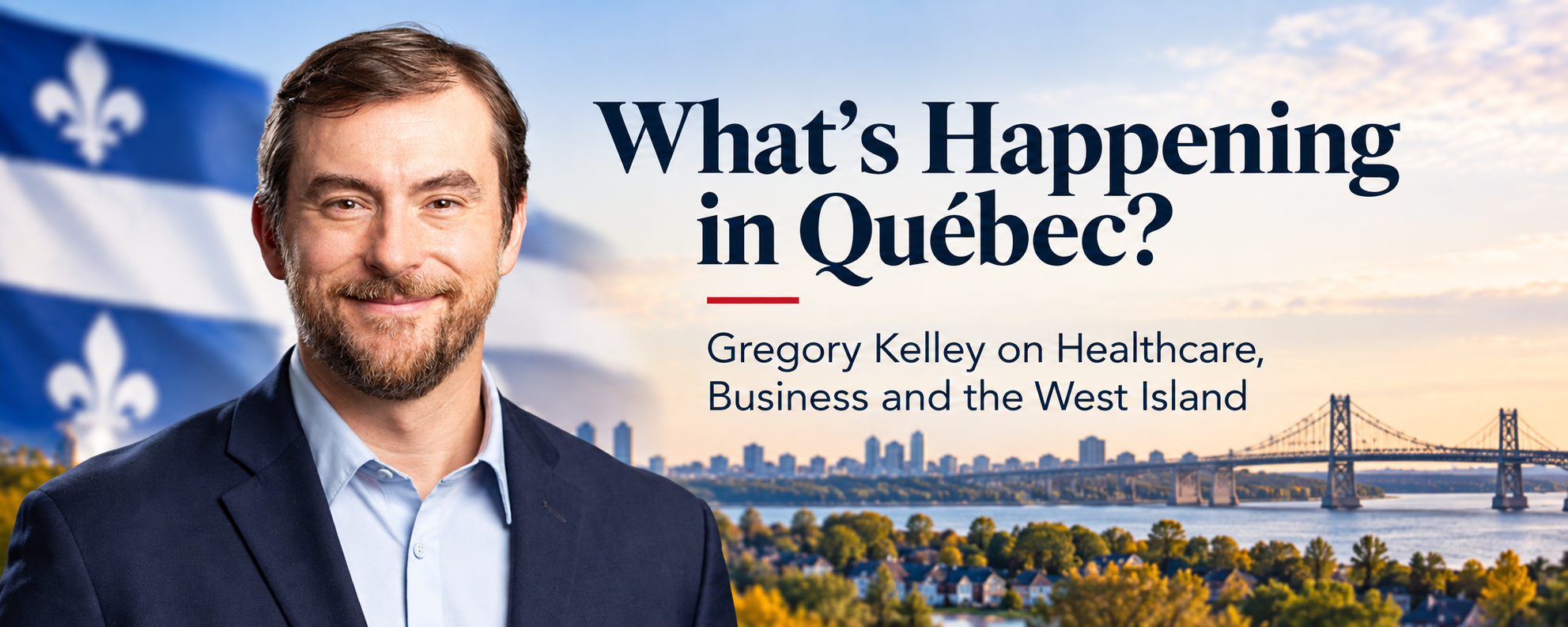
Those were some of the topics that came up when we sat down with Gregory Kelley, MNA for Jacques-Cartier, on the Broady Windsor Group on Real Estate podcast.
The conversation covered a lot of ground. Healthcare. Small businesses. Taxes. Language. Québec sovereignty. Energy. Roads. Young voters. And, because this is the West Island, plenty of discussion about what all of this looks like closer to home.
Here are some of the highlights.
What West Island Residents Are Talking About Right Now
Kelley represents Jacques-Cartier, which includes communities stretching from Senneville through much of the western West Island to Pointe-Claire.
When asked what he has been hearing while speaking with residents, he pointed to several recurring subjects: economic uncertainty, healthcare access, language policy and questions surrounding Québec’s political future.
There is also a more general sense of uncertainty.
The conversation touched on U.S. tariffs and what they could mean for Québec businesses, along with renewed discussion around sovereignty and another possible referendum.
For homeowners, these are not necessarily abstract political debates. Economic confidence, employment, taxation, infrastructure and public services can all affect decisions about where people choose to live, work and invest.
That is one reason we like having these conversations on the podcast. Real estate does not exist in a bubble.
Why Is It So Difficult to Run a Small Business in Québec?
This became one of the liveliest parts of the conversation.
Sean brought the discussion back to something he knows firsthand as a business owner: paperwork.
The forms. The regulations. The different departments. The time spent trying to figure out who is responsible for what.
As Sean put it during the conversation, small-business owners often do not have entire departments available to deal with government administration. When another requirement lands on their desk, they are usually the ones dealing with it.
Kelley discussed his party’s proposals to reduce that administrative burden, including a temporary freeze on new regulations that add to businesses’ workload and a two-for-one approach in which two administrative requirements would be removed for every new one introduced. Those proposals have since been publicly outlined by the Québec Liberal Party.
He was also realistic about the timeline.
Untangling years of regulation is not something that happens in a few months. Kelley suggested that meaningful results could take a year or two because changes can involve several ministries and, in some cases, legislation.
It was one of those parts of the conversation where the political issue quickly became very practical.
If you own a business, you probably know exactly what Sean was talking about.
Québec Taxes, Roads and the Question Everyone Asks
Then came a simple question.
Québec residents pay a lot in taxes. So why do so many people remain frustrated with roads, healthcare and basic public services?
The roads discussion produced a particularly relatable moment.
Sean talked about driving back from Ontario and noticing how quickly the road conditions seemed to change after crossing into Québec. Kelley acknowledged the frustration, while also noting that Québec maintains an extensive road network and arguing that more attention needs to go toward repairing existing infrastructure rather than continually focusing on new projects.
The conversation then moved to the size and efficiency of government itself.
Kelley argued that reducing bureaucracy does not necessarily mean cutting frontline services. Instead, he discussed giving public-sector employees more authority to make decisions without requiring several layers of approval.
That distinction matters.
The question is not simply how much government spends. It is whether residents can actually see the results in the services they use.
Finding a Family Doctor Shouldn’t Be This Complicated
If there was one topic almost any West Island family could relate to, it was healthcare.
Sean and Kelley both have young children, which led to a very familiar example.
Your child develops an ear infection or a fever. Your family doctor is unavailable. You try to find another appointment. Nothing is available nearby. Eventually, something relatively routine can turn into a trip to the Children’s hospital because there is nowhere else to go.
Kelley pointed to the disappearance of true walk-in access as one of the biggest changes he has noticed in frontline healthcare.
Remember when you could walk into a clinic, get a number, leave your phone number and come back when the doctor was nearly ready?
That experience has become much harder to find.
Kelley discussed several proposals from his party, including a public telehealth option, more home care for seniors and greater access to frontline care. The Québec Liberal Party has subsequently proposed a public telehealth portal intended to connect patients with an appropriate healthcare professional when an in-person examination is not required.
The conversation also turned to healthcare workers themselves.
Sean shared that the Broady Windsor Group has worked with doctors who decided to sell their homes and leave Québec for Ontario.
That is where a policy discussion becomes a real estate story.
When professionals decide a province no longer works for them, they do not simply change jobs. Sometimes they move their families and sell their homes too.
What Does the Future Look Like for Anglophone Quebecers?
For many West Island families, language is never very far from the conversation.
Sean raised the balancing act familiar to many anglophone Quebecers: supporting the preservation of French while also wondering what future language policies could mean for their children, businesses and communities.
Kelley discussed his opposition to several policies adopted by the provincial government and argued that protecting French does not require making other Quebecers feel excluded.
The conversation eventually broadened beyond language.
What will Québec look like when today’s young children become adults?
Will they want to build their careers here? Will businesses want to stay?
Will young professionals see Québec as the place where they want to establish themselves?
Those are political questions, but they are also family questions.
And they are questions we hear in real estate more often than you might expect.
Why Is Québec Sovereignty Back in the Conversation?
For a while, another Québec referendum seemed like something belonging to an earlier political era.
Now it is part of the conversation again.
Sean asked Kelley why the Parti Québécois and sovereignty movement had regained attention after years when many younger Quebecers appeared less focused on independence.
Kelley offered his interpretation of the PQ’s resurgence and discussed why he believes federalist parties need to make their case for Canada rather than assuming the sovereignty debate has disappeared.
The conversation also touched on what renewed constitutional uncertainty can mean closer to home.
For West Island homeowners who remember previous referendum campaigns, questions about sovereignty can quickly lead to questions about jobs, businesses, property and whether families remain in Québec.
Whatever someone’s political position, those are significant questions worth understanding ahead of an election.
Energy, Tariffs and Doing More Business Within Canada
Another interesting part of the episode looked beyond Québec.
If doing business with the United States becomes less predictable, should Canadian provinces be doing more business with one another?
Kelley argued that Québec should look at reducing interprovincial trade barriers and expanding opportunities with provinces such as Ontario, New Brunswick and Alberta.
Energy was a big part of that conversation.
Sean asked about pipelines from Western Canada, while Kelley also discussed hydroelectricity, wind, solar, batteries and improving electricity connections between provinces.
His broader argument was that Québec needs enough energy not only for homes but also for future industrial growth.
A manufacturer considering an expansion or a data centre looking for a new location needs electricity. If the capacity is not available, that becomes an economic issue pretty quickly.
What Does an MNA Actually Do All Day?
This may have been one of the most interesting parts of the podcast simply because it had very little to do with campaign promises.
Sean asked Kelley what an ordinary workday looks like when the National Assembly is sitting.
The answer starts early.
Kelley described beginning around 5:30 a.m. by reading the news and catching up on his files. From there, a typical day can include caucus meetings, Question Period, votes, parliamentary committees, meetings, calls from constituents and preparing amendments to legislation.
Some days stretch well into the evening.
One thing he said surprises many constituents is just how much time MNAs spend in parliamentary committees.
Those sessions may not attract the same attention as Question Period, but they are where legislators can spend hours going through proposed laws in detail.
It was a useful reminder that there is a lot of government work most of us never see on the evening news.
The West Island Is Still the Common Ground
After talking about provincial politics for more than an hour, the conversation eventually came back to something much more local.
Community.
Kelley grew up in Beaconsfield and talked about the relationships between residents, businesses, community organizations and different levels of government across the West Island.
Sean sees the same thing through real estate.
People here volunteer. They support local organizations. They raise money. They help their neighbours. They run businesses. They coach teams. They build families here.
And despite all the political questions facing Québec, that local connection is still one of the things that makes the West Island what it is.
Watch the Full Conversation with Gregory Kelley
There is much more in the full episode, including discussions about education, government efficiency, senior care, infrastructure, voting, political financing and the future of Québec.
Rather than trying to squeeze all of it into a headline or a short clip, the full conversation gives you the chance to hear the questions, answers and context for yourself.